Most people understand that wrapping a brisket helps it retain moisture. But the humidity inside the smoker or holding oven also affects juiciness and moisture retention (i.e. “yield”), even after the brisket has been wrapped.
I tested this by cooking meat samples in a CVAP holding oven at very high humidity. A slice cooked to 200°F internal in a humid holding oven retained considerably more moisture than a similar slice cooked to 200°F in a dry holding oven.
What made this especially interesting was that all the samples were covered tightly with foil. The humidity outside the foil still appeared to matter.
I then repeated the experiment with two whole briskets. Both were smoked to approximately 165°F internal, wrapped completely in foil and transferred to a very humid holding oven.
One brisket was cooked to 205°F until probe tender. The other was removed at 195°F and held at 150°F for 18 hours.
Despite the different cooking methods, the briskets were surprisingly similar in tenderness and juiciness. This went against my previous tests, where briskets cooked above 200°F were consistently drier than briskets cooked to a lower temperature and held longer.
The likely difference was humidity during the finishing and holding step.
Why Humidity Matters
Higher cooking temperatures cause muscle proteins to denature. As the proteins unravel and contract, they lose some of their ability to hold water. At the same time, evaporation removes moisture from the surface of the meat.
High humidity cannot completely prevent protein denaturation, but it may reduce evaporation and help the meat retain more water while it cooks. That retained water may also help prevent pores, cells and larger structures inside the meat from collapsing as severely and losing water holding capacity.
This could explain why a brisket cooked above 200°F in a humid environment can remain much juicier than one cooked to the same temperature in a dry environment.
It also suggests that foil is not necessarily airtight. Moisture can still escape through folds, seams and small openings. Butcher paper is even more permeable.
How to Measure Wet-Bulb Temperature
The easiest way to compare humidity between smokers is to measure both dry-bulb and wet-bulb temperature.
Dry-bulb temperature is the normal air temperature shown by your smoker thermometer.
Wet bulb temperature is the temperature at which water evaporates from your brisket in the smoker. In more humid environments where the surrounding air has a lot of water in it, the wet bulb temperature will be higher because water in a piece of meat needs to reach a higher temperature before it can evaporate. For example, if the wet bulb temperature in a dry smoker is 110 degrees, that means the water only needs to reach 110 degrees to start evaporating into the surrounding dry air. Therefore, water will evaporate from the meat early and easily. However, in a humid smoker at 160 degrees wet bulb, the water in the meat needs to reach a higher temperature of 160 degrees before it starts to evaporate into the surrounding, more saturated air. This means less water overall will evaporate from the meat.
In general, a higher wet bulb means higher humidity and less evaporation. Therefore, the meat will retain more water.
To measure wet-bulb temperature:
- Place the tip of a remote temperature probe inside a cotton shoelace.
- Dip the other end of the shoelace in a reservoir of water such as a small metal pan or glass jar.
- Place the wet bulb probe above the reservoir. As water evaporates from the shoelace on the tip of the probe, new water will wick up from the reservoir to saturate it and so on.
- Allow both probes to stabilize.
The uncovered probe measures dry-bulb temperature. The wrapped, wet probe measures wet-bulb temperature.
In dry air, water evaporates rapidly from the cloth and cools the probe, creating a large difference between dry-bulb and wet-bulb temperature. For example, in a very dry environment the dry bulb may read 300 degrees, while the wet bulb reads only 110 degrees.
In humid air, less water can evaporate, so the wet-bulb temperature moves closer to the dry-bulb temperature. For example, in a humid environment the dry bulb may read 300 degrees and the wet bulb reads 160. The difference between the two readings is smaller, which means the environment is more humid.
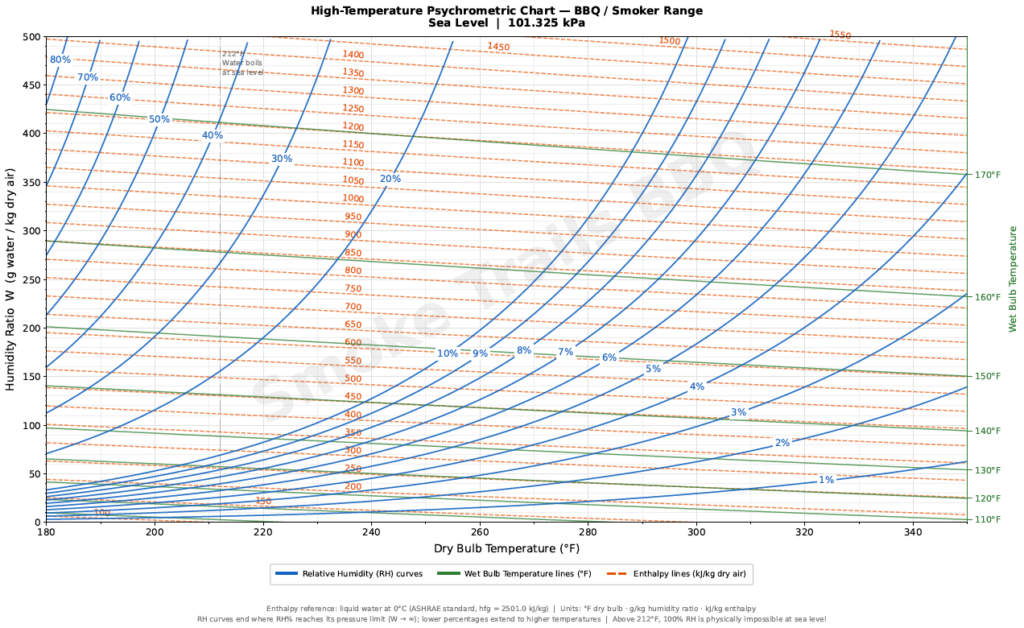
How to Use the Smoke Trails Psychrometric Chart
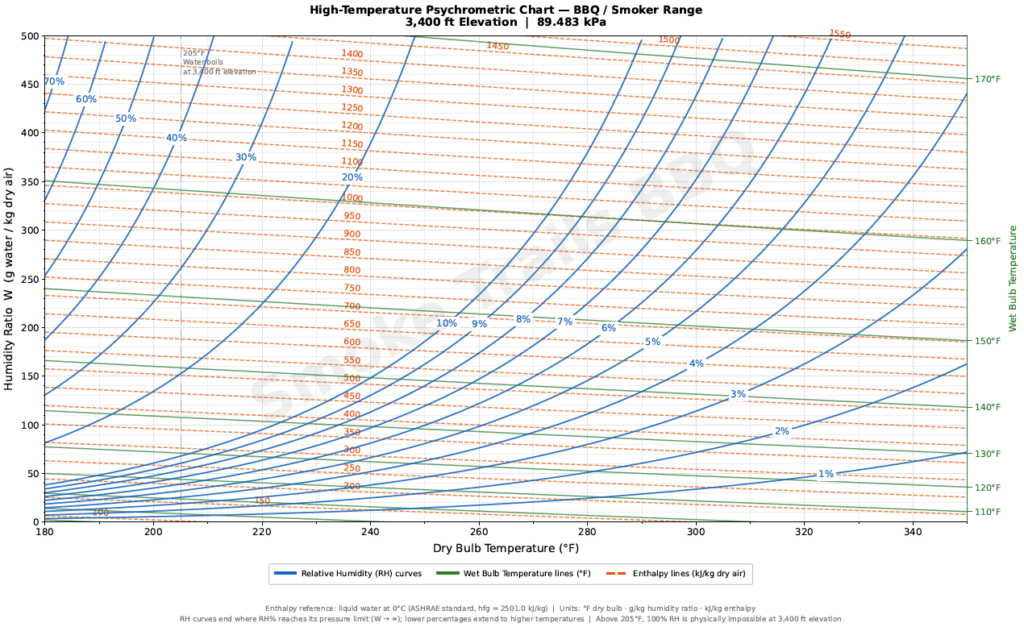
Find your smoker’s dry-bulb temperature on one side of the chart and your measured wet-bulb temperature on the other. Follow the two values until they intersect.
That intersection gives you an estimate of the relative humidity and moisture content of the air inside your smoker.
The smaller the difference between the dry-bulb and wet-bulb temperatures, the more humid the cooking environment.
This lets you compare different setups, including:
- Water pan versus no water pan
- Open versus restricted exhaust
- Humidity of different types of smokers
- Empty smoker versus a smoker loaded with meat
- Dry holding oven versus humid holding oven
My testing suggests that brisket dryness is controlled by more than internal temperature alone. Total time at elevated temperatures matters, but so does the humidity surrounding the meat.
A brisket cooked above 200°F internal in dry air may lose considerably more moisture due to evaporation than a brisket cooked to the same temperature in a highly humid environment. The goal is not necessarily to cook every brisket at maximum humidity, since humidity can also affect bark. But understanding wet-bulb temperature gives you another tool for balancing bark, tenderness and juiciness.
n humid air, less water can evaporate, so the wet-bulb temperature moves closer to the dry-bulb temperature.
The Effect of Elevation on Humidity
Water evaporates much more readily at higher altitudes due to less atmospheric pressure and a lower boiling point. Therefore, if you live roughly ~2,000 feet or more above sea level you should use the “3,400 Feet Elevation” version of the chart below. If you live at an elevation below 2000 feet then use the sea level chart below.